Pages

Sunday, 9 September 2012

The Workmen's Huts in the Theban Mountains: Documenting the royal tomb-builder's huts above the Valley of the Kings

Yesterday I attended an excellent study day organised by the Egypt Exploration Society which focussed on 'Theban Mountains Project', being the current work of Jaana Toivari-Viitala and her team at the so-called 'Workmen's Huts' on the west bank at Thebes, funded by the Academy of Finland. This project, begun in 2008 and due to finish in 2013, is building upon the work of IFAO at the site under Bernard Bruyère in 1935 and the Finnish team have the challenge of finding out exactly why these stone huts were built, and for whom. The huts are commonly attributed to the workmen who built the royal tombs in the Valley of the Kings who lived at the village of Deir el-Medina during the 19th and 20th Dynasties.
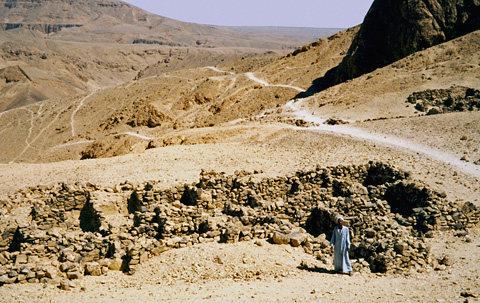

Workmens huts on the Theban Mountain


(Photo: https://egyptsites.wordpress.com/2009/02/10/deir-el-medina-workmens-village/)


The remit of the project is as follows:

'A multidisciplinary study on human agency, housing construction and social and ritual space in Egypt 1550-1069 BC with special focus on the 'Station de Repos' area [the 'Workmens' Huts']'.

The team are using the same numbering system that Bruyère established in the 1930's, and have split the excavation area into three sections: the Northern (worked on in 2008-9), Eastern (worked on in 2010) and Western (2011) clusters. The plan of the site made by the team differs slightly from the original plan by Bruyère and is more precise. 

Dr. Toivari-Viitala split her lecture into two sections; the first presenting the archaeological setting of the huts within the context of the Theban landscape, and the second focussing on the finds from the site. Despite searing working temperatures - sometimes hitting 63°c - and often challenging working conditions dealing with the garbage which constantly accumulates at the site, the team have made some fascinating discoveries since 2008, including the following:-

- 141 stone huts have been found at the site by the team to date.


-  The floors of the huts were often covered with a limestone plaster made from local stone.

- 'Mastabas', or benches, were a regular feature in the huts, which were normally between 20-30cm in height. The mastabas were typically marked out with large boulders and filled with loose earth and rubbish, and the whole mastaba was then covered with white plaster to make a smooth surface for sitting. One unusual rock-cut 'mastaba' was also found by the team, although the precise nature of this features remains questionable as it is also much taller than the other mastabas in the group (c. 70cm).


- Limestone slabs were also used as thresholds, and would have been placed over loose boulders and plastered.


- Fossilised shells, commonly found on the Theban hills, were used as fill for the walls of the huts.


- New Kingdom pottery were discovered as fill in the mastabas.

- Remnants of 20 fireplaces have been found both inside and outside the huts, identified by surviving ashes. New Kingdom and Coptic pottery have been found inside two of these fireplaces which proves that the site was also utilised during the Coptic Period.

-  A partly-finished bundle of textile rags containing 27 lamp wicks has also been discovered, together with used pottery lamps.


- A small shrine with a single central room has been identified with two unusual small spaces at each side, what Dr. Toivari-Viitala referred to as 'dummy spaces', which seem to be too shallow for storage. There are also roughly-cut hieroglyphic graffiti on the rock-cut steps at the edge of the shrine.

-------------- 

But the precise motivation for the construction of the huts remains a mystery. Some ideas concerning the site's function were debated by the audience:-

1. Game boards and gaming pieces have been found, which some members of the audience suggested might be evidence of the huts being used as a 'gentleman's club' - a place for the husbands to have a break from their wives who lived at Deir el-Medina.


2. Was it a purely administrative area for the workmen to check the tools in and out on the way to and from the Valley of the Kings? Evidence of the well known scribe Qenherkhepeshef (temp. Ramesses II) at the site, including three rooms which he used, may support this theory, but then why the gaming boards? Were they simply used while the administrative staff at the huts were bored or had time to kill? 

3. The big question still remains that after the workmen had finished their daily work in the Valley of the Kings, it must have been more difficult to walk up to the top of the mountain to the huts, than to walk down to Deir el-Medina at the bottom of the mountain, and wouldn't they rather have wanted to go home if they were already halfway there? That the northern wind is quite strong at the site may suggest that it was used as a halfway point during the very hot summer months.

Dr. Toivari-Viitala presented a compelling argument but it is clear that the precise function of the site is yet to by fully established. However, it was fascinating to hear more about the work of the team, particularly to see some of the finds from previous seasons, and certainly a great day was had by all. A great benefit was that many of the audience had previously visited the site and walked over the Theban hills from Deir el-Medina to the Valley of the Kings, so the discussion was particularly engaging. I look forward to hearing more after next season to see whether more tantalising details are revealed, and would welcome any comments if readers have any further ideas to contribute!


Peter Pan in London: Great Ormond Street Statue

Since I was a child I've been captivated by J. M. Barrie's Peter Pan, and while in London I'm making the most of easy access to Pan-related features of the city. I had previously visited Kensington Gardens, near to where Barrie lived, to see the famous bronze Peter Pan statue erected in 1912. This week I visited Great Ormond Street Hospital where a statue of Peter and Tinkerbell stands in a little garden in the forecourt of the hospital, unveiled in 2000. Barrie generously gave the rights to Peter Pan to Great Ormond Street Hospital in 1929, and the hospital has benefited greatly from royalties ever since.


Saturday, 25 August 2012

Egyptianising London: Cleopatra's Needle Benches

Whilst in London for 2012 I am trying to seek out Egyptianising monuments around the city. Although I'd seen "Cleopatra's Needle" on the Thames Embankment a few years ago I'd previously failed to note a group of benches set up next to the obelisk in the form of elaborate winged female sphinxes, wearing the nemes-headdress with uraeus. The benches have individual plaques recording their donors, who include W. H. Smith


Sunday, 17 June 2012

Cinematic Necropolis: Egypt in NE London

Yesterday I attended a walk organised by the Petrie Museum entitled 'Cinematic Necropolis', intended to explore Egyptianising monuments in North-East London. Being a newcomer to the city, and indeed to the Islington area, this seemed the perfect opportunity to combine local sightseeing with an interest in Egyptian-style architecture. Despite the threat of rain the group gradually assembled at the Carlton Cinema on Essex Road, Islington, which was the first stop on the walk.

This Grade II-listed building was designed by George Coles in 1930 in the Egyptian style which was particularly fashionable at the time as Egyptomania gripped the world. An interesting talk was given by Cathie Bryan on Egyptian temple architecture and how different elements of the ancient temples were combined to form the unique Carlton Cinema building, particularly the illusion of perspective through the use of different-sized columns to suggest that the viewer is actually looking through the 'temple pylon' to the courtyard beyond. Cathie's presentation of comparable temple-style buildings in both the UK and the USA was useful for placing the Carlton in the context of contemporary architectural design. The building was unfortunately closed to the public in 2007 after its reuse as a Bingo hall so we were unable to gain access to the interior, but from archive photos it is believed to have had a Neoclassical theme.

The front gates of Abney Park Cemetery
From the Carlton the group hopped onto a bus towards Abney Park Cemetery - just as the rain started! - where we arrived at the rear gates of the cemetery about 15 minutes later. Once again Cathie presented the history of the cemetery to the group, and pointed out significant headstones such as that of William Booth, founder of the Salvation Army. I was pleasantly surprised to discover that the cemetery also functioned as a nature reserve and arboretum, which seems to make Abney Park Cemetery more a place of life rather than death. 

But it was the front gates of Abney Park which the group had come to admire, which we reached just in time as the cemetery was being closed due to the high winds and the threat of falling branches. The gates were designed in 1840 by Prof. William Hosking and Joseph Bonomi Jr. in the Egyptian style, complete with a hieroglyphic inscription which states 'Abode of the Mortal Part of Man'. The elaborate column capitals and winged sundisc motifs, combined with the flower-bud design on the cast-iron gates, makes the cemetery frontage unmistakeably Egyptian.

A hieroglyphic inscription on the Abney Park gateway
One of Abney Park's Egyptianising columns
I highly recommend a visit to either of these monuments to anyone with an interest in Egyptianising architecture, and to keep up with the Petrie Museum Events page for similar events in the future. Many thanks to Debbie Challis, Jan Picton and Cathie Bryan for organising a great day out!

Saturday, 16 June 2012

Image of the Week #5: Discobolus in the Great Court

After a particularly hectic few weeks I'm finally going to pull my socks up and blog! To start with, here's a photo of the Townley Discobolus (Discus-Thrower), which is currently on display in the Great Court of the British Museum as part of the London Olympics celebrations.

This famous marble statue is a Roman copy of a 5th Century BC Greek bronze sculpture, and was found, along with many other statues, in the grounds of Hadrian's villa at Tivoli, Italy.

For more on the recent redisplay of the Discobolus, listen to this BBC interview with Dr. Ian Jenkins, Senior Curator at the British Museum.


Sunday, 15 April 2012

Image of the Week #4

Here's a shot of the British Museum's touring 'Pharaoh: King of Egypt' exhibition from my visit to Leeds City Museum on Saturday (April 14th), with the iconic upper section of a colossal statue of Ramesses II in the foreground and a statue of a seated falcon behind the cartouche of Ramesses II in the background (more photos of the exhibition to follow).

Wednesday, 4 April 2012

Visiting Haweswater

I finally made it to Haweswater last Sunday (April 1st) long after gaining an interest in the site after reading a book about Mardale and the Haweswater Reservoir from Kendal Library as a child (see previous blog post: Mardale: A Village Lost).

Here's a photo taken from beside Haweswater Reservoir, at the opposite end of the reservoir to Haweswater Dam. Unfortunately (though fortunately with regards to the country's water supply!) the reservoir was not low enough to reveal Mardale, but I hope to make it up there again soon when the water may be a little lower.

Yan Tan Tethera: A rhyme derived from a Brythonic Celtic language used by shepherds to keep sheep in many parts of England and Southern Scotland.

Until the Industrial Revolution, the use of traditional number systems was common among shepherds, especially in the Dales of the Lake District.


[This Blog is best viewed in Mozilla Firefox]

Total Pageviews