Pages

Saturday, 16 August 2014

Egypt in London 2014: Carreras Cigarette Factory, Camden

I'm back in London and happily reviving my discoveries of Egyptianising architecture in the city. This week I was walking down Mornington Crescent with friends when something caught my attention, and as a result I was completely soaked by a passing bus veering through a huge puddle! Nevertheless my spirits weren't too dampened since that distraction was in fact the wonderful old Carreras Cigarette Factory in Camden, now Greater London House. 

This building is another incredible illustration of the early 20th century vogue for Egyptianising architecture in London, much like the Carlton Cinema on Essex Road, juxtaposing 'traditional' ancient Egyptian temple elements in a distinctive Art Deco design. It was erected in 1926-28 by the Carreras Tobacco Company and the original design included an ornamental winged solar disk and two colossal seated bronze cat statues flanking the entrance in the form of the cat goddess Bastet. Carreras used the black cat as a marketing device; their cigarette packets also included a similar image. The main facade of the building was composed of a row of twelve brightly-painted papyriform columns and the handrails of the main entrance took the form of serpents. The outer ornamental railings incorporated a series of hieroglyphic motifs including the djed-pillar and decorative lotiform elements.

The official opening of the building was a grand event, including a procession of cast members from the contemporary theatrical production of Aida and a chariot race on Hampstead Road. It has since been argued that this design may have been deliberately chosen by the company in order to associate their cigarettes with the glamour and luxury of ancient Egypt. 

During the 1960s many of the original Egyptianising elements were removed, in order to give the building a more minimalist modern appearance when it became Greater London House. Thankfully these elements were restored in the 1990s when the building was returned to its former Egyptianising glory, though interestingly the winged solar disc above the main entrance was not restored since it was considered to closely resemble the eagle imagery of the Third Reich. 

A very pleasant chance discovery on a rainy London day!

Thursday, 24 July 2014

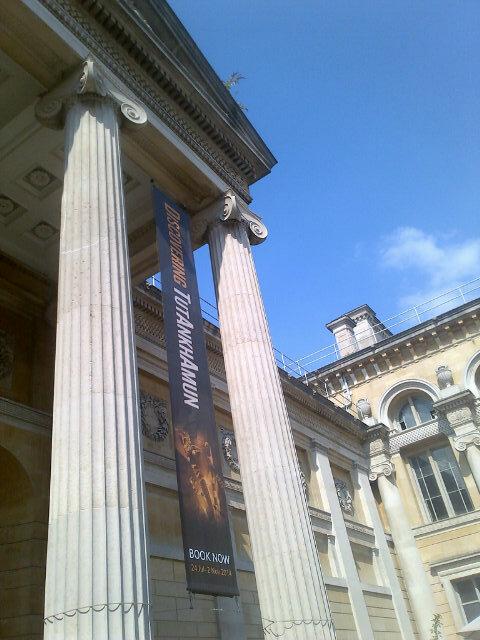
For the Love of Tut: Discovering Tutankhamun at the Ashmolean Museum

'There is only one topic of conversation... one cannot escape the name of Tut-Ankh-Amun anywhere...'
New York Times, 1923

I had the pleasure of attending the private view of the 'Discovering Tutankhamun' exhibition at the Ashmolean Museum yesterday; a major Egyptological event which delighted the media and the hundreds of guests who enjoyed the great hospitality of the Museum as well as a sneak-peak at the Museum's summer exhibition. 

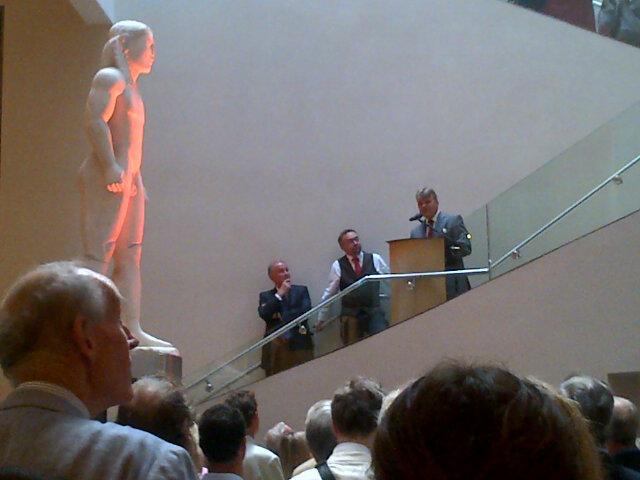
The exhibition was officially opened by the 8th Earl of Carnarvon, whose rousing speech followed those of Christopher Brown (Ashmolean Director) and Prof. Richard Parkinson (Professor of Egyptology, University of Oxford). 

On entering the exhibition the visitor is introduced to a gallery space showcasing Howard Carter and his work in Egypt before the discovery of Tutankhamun's tomb - the project which subsequently became his life's pursuit. A personal favourite is a famous painting from Carter's work at the temple of Hatshepsut at Deir el-Bahri in Thebes showing a beautifully reproduced Horus falcon. 

The background setting moves rapidly into the wonderful discovery, told through diary entries and correspondence, which Carter made on November 4th 1922 - the first step leading down to the tomb, which he and the 5th Earl of Carnarvon entered three weeks later. 

The beauty of the exhibition is that it tells the story of the discovery by intertwining ancient and contemporary objects with rare archive material from the Griffith Institute, and in doing so effectively illustrates the different stages of discovery, study and conservation, and ultimately the painstaking removal of the many hundreds of objects from the tomb, not to mention the politics associated with such an overwhelmingly vast task.

This technique of display highlights the different roles of those individuals involved in the project - artists, conservators, linguists, scientists, and photographers: the products of Harry Burton's pioneering photographic work in particular formed impressive backdrops to the gallery. I was pleased to see Griffith archive material that I'd never seen before, including beautiful and incredibly detailed artwork of some of the finds from the tomb by Nina de Garis Davies and Winifred Brunton

The exhibition then transports the visitor back in time to the 1920s, when 'Tut-Mania' took over the world. This immersive experience includes cases full of Egyptianising and Tut-inspired products from the UK and beyond, including a Cartier brooch in the form of a winged scarab and some tiny ladies' gloves embroidered with ancient Egyptian hieroglyphs, all while listening to the original recording of 'Old King Tut' by William Jerome and Harry von Tilzer from the height of Tut-Mania in 1923. 

It was also fascinating to see the general public's reception of the great discovery - from letters written to Carter asking for 'souvenirs' from the tomb, to those wishing him luck and giving him tips on how to avoid the 'Curse of the Pharaoh' which had already 'claimed' Lord Carnarvon. Contemporary newspaper articles are also on display, alongside Carter's wooden cabinet full of slides which he used to present the incredible story of his discovery to an insatiable public. 

The exhibition concludes with an overview of Tutankhamun's historical context: the Amarna Period and it's aftermath. Here I was delighted to see objects from Berlin and the Metropolitan Museum which I'd never seen before, as well as large-scale British Museum sculpture in a new display context including a statue of Tutankhamun as a priest of the god Hapy, likely from Karnak (EA 75). My only issue with this display is that the complex history of the period is somewhat condensed in order to fit into that space, but of course if the visitor would like to know more then they can certainly fill their boots in the excellent Amarna Period section of the Museum's newly-redisplayed Egypt and Sudan gallery downstairs. 

A final section introducing the recent facsimile of the tomb made by Factum Arte, and an exhibition of replica objects from the tomb by Semmel Concerts, explores current issues in presenting Tutankhamun and his story to a worldwide audience always thirsty for their own 'Tut' experience. The icing on the cake was seeing digitally coloured versions of the original 1920s black-and-white photography, and the seated portrait of Howard Carter, painted by his brother William, from the Griffith Institute. 

As you might tell there is far too much for me to fit into one post and this is really only skimming the surface of an exhibition truly full of 'wonderful things'; things which have been successfully curated to make the story of 'Discovering Tutankhamun' appeal to the widest possible audience, whilst including all of the finer details necessary for a nuanced discussion of the discovery. 

I'd like to extend grateful thanks to the Ashmolean Museum, and to Liam McNamara for the opportunity to attend the Private View. I look forward to attending the exhibition events due to run over the coming months (the exhibition runs from 24 July 2014 to 2 November 2014) - in the meantime follow #DiscoverTut to find out more and see the exhibition trailer here

Sunday, 1 September 2013

Future Curators hit the North-East: Visiting the Great North Museum and Durham's Oriental Museum

One of the GNM: Hancock displays
Despite living within spitting distance of the north-east for the past 27 years I had never visited Newcastle or Durham, so I was particularly happy when a Future Curators visit was arranged this week. After a tour of their stores we visited the Great North Museum: Hancock and I made a bee-line for their Egyptian galleries. The GNM's Egyptian collection is made up partly of their own objects and also of a long-term loan from the British Museum. The gallery was arranged thematically which in most cases worked well, typically splitting the gallery into aspects of life and death in ancient Egypt. 

Visitors heading into the Afterlife interactive
Signing and video accompaniment
Snakes in the Underworld
The way the museum did this however was pretty innovative: after visiting the 'life' part of the gallery, the visitor passes through an interactive doorway into the next life on the condition that they successfully pass through the dangers of the underworld. We visited at the end of the day when the gallery was quiet and the experience was a bit disconcerting, especially when the snakes slither past! A booming voice reads through the tasks while a computer screen with signing and subtitles for those hard of hearing, making it a meaningful and memorable experience for all visitors. The collection itself contains several important pieces and overall I enjoyed the layout and design of the gallery though I would have liked to see more information on the object labels, particularly provenance and accession number, and the gallery also had a number of other interactive stations but unfortunately some of these were out of order so I look forward to using them on my next visit.

Durham Oriental Museum
Sphinx of Tuthmosis IV
We then trekked to Durham's Oriental Museum where we were greeted by friendly staff and a beautiful museum, not so large in size but with an incredibly important Egyptian collection. Two galleries are named after Prof. T. W. Thacker, Director of Oriental Studies at Durham from the 1940s until 1977 and contain objects acquired from the Duke of Northumberland's Collection (Prudhoe Collection), the Wellcome Collection and from the sponsorship of fieldwork in Egypt and Sudan during the 1950s and 1960s. 

Steatite statuette of Amenhotep III
The overall layout of the galleries and use of the space was appealing; each object is relevant to the thread of the collection story and several key pieces were exhibited in their own cases, well-lit, as highlight objects, including my personal favourite - a glazed steatite statuette of Amenhotep III from his memorial temple at Kom el-Heitan, Thebes (EG 3998). I was also pleasantly surprised to learn that a diorite sphinx of Tuthmosis IV on display (EG 3997) was the inspiration for the two bronze sphinxes flanking Cleopatra's Needle on the Embankment in London. And of course it was a pleasure to finally see the beautiful wooden servant girl; probably the most famous Egyptian object in the whole collection (EG 4007; temp. Amenhotep III).

Throughout the museum the panels were word-heavy which I don't think is necessarily a bad thing for a University Museum, though I found myself sticking with the object labels provided as laminated handouts next to each case; a technique which I would normally question as it can sometimes make finding the objects rather time-consuming, however it worked very well as most cases were not particularly full and the labels contained a lot of useful information. 
Snippet of the 'Satire of the Trades' alongside ancient Egyptian tools
I also enjoyed the use of snippets of Egyptian literature in some of the cases, which added interest and helped to bring the objects to life for visitors. I think my only bugbear was the lack of Sudanese objects on display from their collection, or when they were on display (e.g. a vessel from Buhen) the provenance was not named. Overall though definitely worth a visit and happy to have had the opportunity to spend an afternoon in the galleries and have a chat with the staff of the museum.

Sunday, 25 August 2013

Visiting West Park Museum, Macclesfield

This week I visited West Park Museum in Macclesfield on an afternoon trip with my
West Park Museum
supervisor Campbell to see their collection of Egyptian objects. West Park's small but well formed Egyptian collection came into being because of a Miss Marianne Brocklehurst, the child of a wealthy silk manufacturer in Macclesfield and a lady with a keen interest in all things ancient Egyptian. 

Miss Brocklehurst travelled around Egypt with her companion Mary Booth, and the pair became known as the 'MBs'. They had a keen eye for high-quality Egyptian objects and had the opportunity to acquire a personal collection when they also had the chance of making use of their contact with Luxor's infamous Abd el-Rassoul family from whom they bought a number of objects including this ring preserving the cartouche of Ramesses II. 
Ring with the cartouche of Ramesses II
Miss Brocklehurst was also a friend of Amelia Edwards (the founder of the Egypt Exploration Fund, now Society) and subsequently became a member and donor of the EES, forming a Macclesfield Branch of the EES with Mary Booth as secretary. As a result of her membership Miss Brocklehurst received a portion of the excavated objects with secure contexts which complemented her own personal Egyptian collection. 

West Park Museum was built in 1898 at the instruction of Miss Brocklehurst but unfortunately she became ill and died before she was able to visit the museum herself. From museum records it is clear that Miss Brocklehurst's Egyptian collection was donated and exhibited at West Park from the very beginning, and now forms an integral part of West Park's modest collection of ancient objects, anthropology, natural history and fine art.  

One of the most important Egyptian objects at West Park is this beautiful steatite statuette of Queen Tiye, Great Royal Wife of pharaoh Amenhotep III (1390-1352 BC) depicting the queen standing, wearing an enveloping wig and vulture headdress which may originally have been fronted with two uraei. She holds a flywhisk in her left hand and a lotus in her right, and the back pillar preserves her name: Hmt-nsw wrt Tyy (Great Royal Wife, Tiye). This object is truly a masterpiece and I was very lucky to have had the privilege of handling and examining it on my visit. 

The West Park Museum may be small, and perhaps a little out of the way, but it is definitely worth a visit and you will be rewarded with a beautiful collection of Egyptian objects including several outstanding unique pieces, together with a CD ROM catalogue of the Egyptian collection which you can purchase from the museum shop. I'd like to thank Honorary Curator of West Park, Alan Hayward, for his generosity and for facilitating access to the collection.

Sunday, 28 April 2013

Catching the Trade Winds: Photographing my Travels

I'm going to share more of the photos that I take of Egypt and Sudan, as well as photos of museum visits in the UK and Europe, using Picasa albums. To start this off: my visits to the Temple of Amenhotep III at Soleb, Sudan, and the Neues Museum in Berlin. All images taken with an Olympus E320 DSLR. You can find the links to the images to the left in a folder named "Albums: Egypt and Sudan".

You may also like to watch this short BBC Timewatch video featuring Soleb Temple.

Sunday, 14 October 2012

Pylons, Obelisks and Time Travel: An Egyptianising Tour of Brompton Cemetery

Yesterday I attended another of Cathie Bryan's wonderful walking tours of the Egyptianising monuments of London, this time the Petrie Museum's 'Egypt Undead' tour of Brompton Cemetery in South-West London. This cemetery covers 16.5 hectares and is described as 'one of the finest cemeteries in the country', containing a number of monuments of great historical interest including that of Emmeline Pankhurst, leader of the British Suffragette Movement. 

As this tour was organised by the Petrie Museum, the main focus was on the Egyptianising and Egyptology-related monuments in the cemetery. It is clear that particular features were used for Egyptianising burials in London during the period 1700-1900 which appear time and time again, including the obelisk and the temple pylon (see also Kensal Green and Abney Park cemeteries). We also saw these motifs at Brompton, though some have unusual details:

Obelisk memorial with Japanese characters of Jugoi Nagayori Asano (1865-1886)
One monument with an unusual history is that of Hannah Courtoy, an illustrious individual who possessed a huge fortune. This structure is shaped like an Egyptian temple-pylon and apparently no documentation of the construction of the monument within the cemetery survives. This somehow led to a belief that Courtoy's monument was proof that the Egyptians had invented time-travel!

Magnificent Egyptian temple pylon-style monument of Hannah Courtoy (1784-1849)
Temple pylon-style monument of Charles Thompson, built in 1881

Another pylon-style monument of Augustus Horsfall Bill, built in 1874


Most interesting of all was the grave of Joseph Bonomi and his family. Bonomi was an artist, sculptor and Egyptologist who famously worked in Egypt with Robert Hay in 1824. He was the Egyptologist curator of the Sir John Soane Museum, London, and also worked at the British Museum most famously on Hay's Egyptian temple casts. Sadly Bonomi lost four children in one week due to whooping cough, and his wife soon afterwards. Their family monument was engraved with Anubis, Egyptian god of the afterlife.

Joseph Bonomi's family monument
Detail of Bonomi's grave
The Brompton walk was a great way to spend an crisp Autumn afternoon in London and once again the group were kindly treated to tea and delicious biscuits by the Friends of Brompton Cemetery. My heartfelt thanks go to Cathie Bryan for her kindness in arranging for me to attend the tour.

Sunday, 30 September 2012

Travellers and Egyptomania: A guided tour of Kensal Green Cemetery

I am gradually making my way around the Egyptianising monuments of London during my time in the city working at the British Museum. My most recent visit was to Kensal Green Cemetery as part of a guided tour organised by ASTENE (Association for the Study of Travel in Egypt and the Near East) led by Cathie Bryan, who also led the excellent 'Cinematic Necropolis' tour organised by the Petrie Museum which I attended in June 2012.

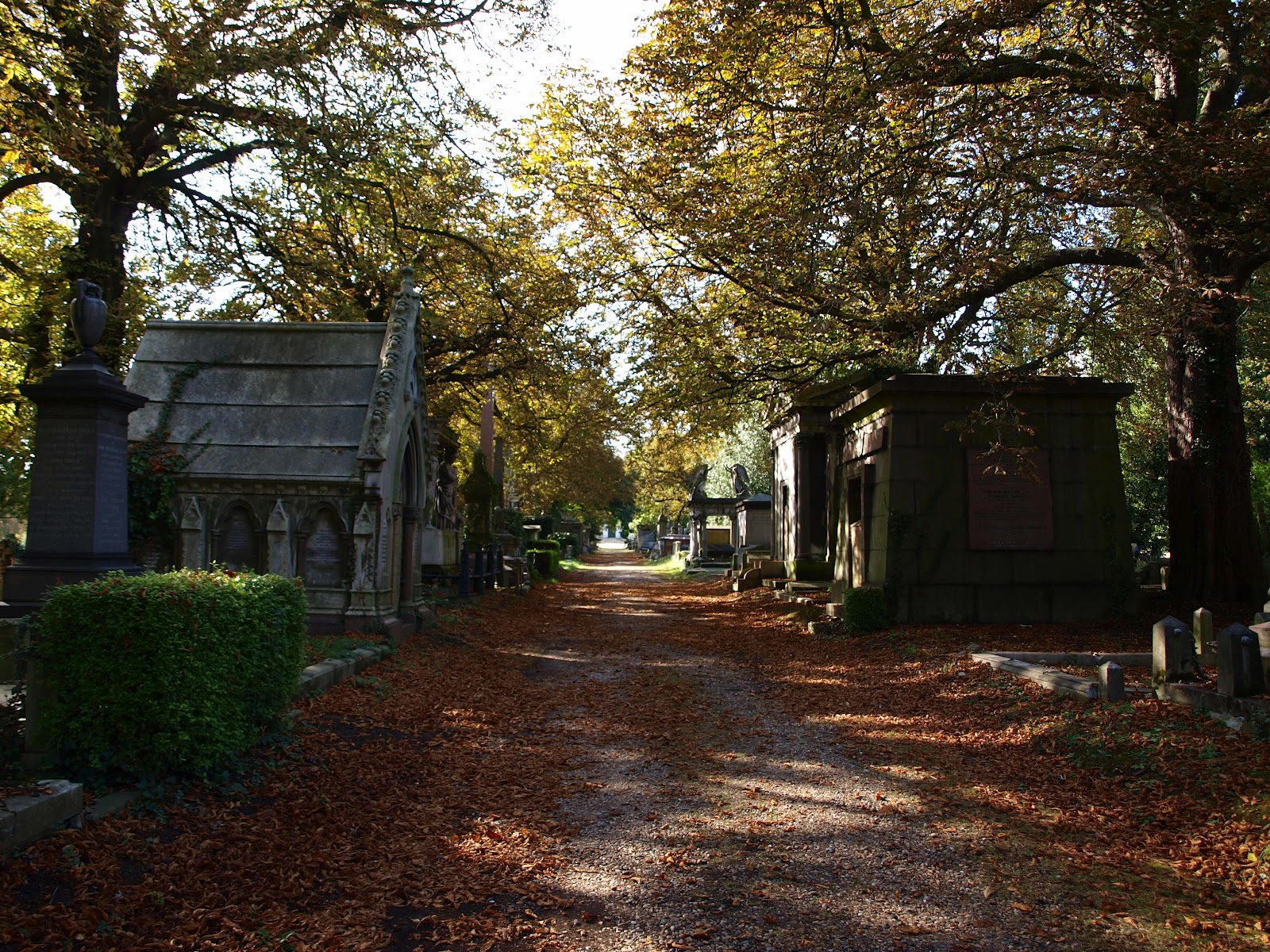
Unlike the rainy Petrie tour in June, the autumn sun shone beautifully on the cemetery and the leaves were crisp on the ground. At Kensal Green, one of London's oldest public cemeteries, Cathie's tour was intended to highlight monuments of well-known travellers as well as those in the Egyptianising style. The group slowly made their way around the cemetery - together with a playful local cat - on a two-hour tour which included the following monuments:

John McDouall Stuart (1815-1866) in the form of an Egyptian obelisk

Isambard Kingdom Brunel (1806-59) - Mechanical and Civil Engineer

General Sir William Casement (1780-1844) -  a British General who served in India

Sir George Harris (1827-1902) in the form of an Egyptian temple pylon with winged sun disk (with Cathie)

Sir George Farrant (1770-1844) in the form of an Egyptian temple pylon with a winged sun disk and a stylised winged Hathor-head

Detail of above

Andrew Ducrow (1793-1837) in the form of an Egyptian temple pylon with winged sun disks and sphinxes

John Shae Perring (1813-1869) - Engineer who worked with the Egyptologist Howard Vyse, in the form of an Egyptian pyramidion

Lt. Col. Charles Seton Guthrie (1805-1874) in the form of an Egyptian temple pylon with metal grilles in the form of stylised Egyptian cartouches (detail below)


The friendly local cat who followed the tour!
The tour ended in the Anglican Chapel where the group was treated to well-earned hot drinks and biscuits. Many thanks once again to Cathie Bryan, and also to Patricia Usick for organising a fascinating day out.
Yan Tan Tethera: A rhyme derived from a Brythonic Celtic language used by shepherds to keep sheep in many parts of England and Southern Scotland.

Until the Industrial Revolution, the use of traditional number systems was common among shepherds, especially in the Dales of the Lake District.


[This Blog is best viewed in Mozilla Firefox]

Total Pageviews